
Pond Maintenance · Troubleshooting
Is My Pond Losing Water? How to Tell If It’s Evaporation or a Leak
Your pond losing water is one of the most common calls we get from New Jersey pond owners every summer. Before you tear anything apart, here is how to figure out exactly what is going on.
By Jaak Harju · Atlantis Water Gardens · Updated May 2026
You walk out to check on your pond and the water level is noticeably lower than it was yesterday. Your first instinct is that something is wrong. And sometimes it is. But more often than not, what you are seeing is completely normal and understanding the difference can save you a lot of stress, time, and money.
A pond losing water in New Jersey during a hot summer week is not automatically a cause for alarm. Evaporation is real, it is significant, and it catches even experienced pond owners off guard. The key is knowing how to measure what is normal for your specific pond, and how to quickly rule out a leak when the numbers do not add up.
TL;DR
Most New Jersey ponds lose 1 to 2 inches of water per week to normal evaporation. If your pond is losing more than that, do the bucket test first. If the pond drops more than the bucket over 24 hours, you likely have a leak. Start your search at the waterfall liner edges, then check plumbing and the full perimeter of the liner.
How Much Water Should a New Jersey Pond Lose to Evaporation?
This is the question every pond owner needs a solid answer to before panicking. According to our experience building and maintaining ponds across Morris County since 2000, most backyard ponds in New Jersey lose somewhere between 1 and 2 inches of water per week under normal summer conditions. That works out to roughly a quarter inch per day on a typical warm day.
However, several factors can push that number higher on any given week:
- High temperatures and direct sun exposure all day
- Strong winds, which dramatically increase evaporation rate
- A large waterfall or stream that moves a high volume of water over rocks
- Low humidity days, which are common during NJ heat waves
- A larger pond surface area exposed to sky
On a hot, breezy July day in Rockaway or Parsippany, it is not unusual for a pond with an active waterfall to lose close to half an inch in a single day. That is still evaporation, not a leak.
1How to estimate your pond’s daily evaporation rate
Every pond is different, so the best approach is to calculate an estimate specific to your setup. Here is a simple method used by pond professionals:
Evaporation Estimator: Step by Step
Step 1. Measure your pond’s surface area in square feet. For a roughly 11×16 foot pond, that is approximately 150 square feet.
Step 2. Multiply surface area by 0.62 to get gallons per inch of depth. Example: 150 x 0.62 = 93 gallons per inch.
Step 3. Estimate your pump’s flow rate in gallons per hour (GPH). Check your pump specs. A typical setup might run 2,500 GPH.
Step 4. Multiply GPH by 0.5% (0.005) to estimate daily evaporation from water movement. Example: 2,500 x 0.005 = 12.5 gallons per day.
Step 5. Divide your gallons per inch (Step 2) by daily evaporation gallons (Step 4). Example: 93 / 12.5 = 7.4. This means your pond can lose 1 inch of water every 7 days through normal evaporation. Anything faster than that is worth investigating.
This gives you a baseline to work from. If your pond is losing water noticeably faster than your estimate suggests it should, move on to the leak test below.
2The bucket test: the fastest way to rule out a leak
This is the single most reliable test you can do at home and it costs nothing. Here is exactly how to do it:
- Fill a bucket with water from your pond
- Mark the water level inside the bucket with tape or a marker
- Place the bucket on a pond shelf or ledge so it sits at the same level as the pond surface
- Mark the pond’s current water level at the edge
- Leave both for 24 hours with the pump running normally
- Compare the two levels after 24 hours
If the pond and the bucket have dropped by the same amount, what you are seeing is evaporation. Both are losing water at the same rate to the same conditions. If the pond has dropped significantly more than the bucket, you have a leak and it is time to start looking for the source.
Important
Run the test with your pump on. If you then repeat it with the pump off and the water loss stops or slows significantly, the leak is likely in your waterfall, stream, or plumbing rather than the pond liner itself.
3Where to look first if you have confirmed a leak
If the bucket test confirms your pond is losing water beyond normal evaporation, here is where to start your search. In our experience across thousands of NJ pond builds, these are the most common culprits in order of likelihood:
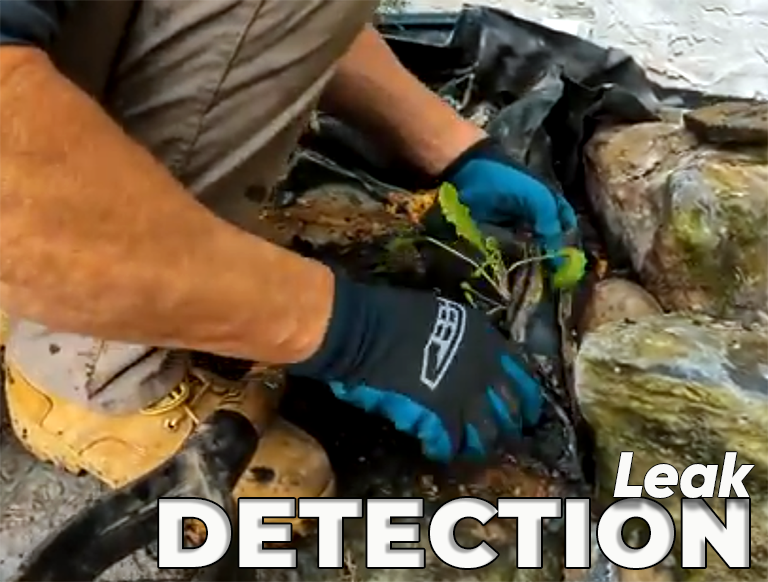
- Low edges in the waterfall or stream liner. Soil settles over time, and a liner edge that was once level can drop and allow water to escape over the side. Walk the entire waterfall and stream and look carefully for any wet soil or damp areas outside the liner.
- A shifted waterfall stream that is spilling water outside the liner at a curve or turn
- A liner puncture near the edge of the pond from a sharp rock, root, or landscaping work
- A loose or deteriorated plumbing fitting at the pump, skimmer, or biofalls unit
- A crack or separation in the skimmer or biofalls box where it meets the liner
Turn off the pump and watch the water level for 24 hours. If it holds steady with the pump off, the leak is in the waterfall or plumbing. If it continues to drop, the liner itself is the likely source.
4Signs that tell you it is definitely not just evaporation
Some situations make it pretty clear that evaporation is not the whole story. If you are seeing any of these, trust your instincts and start investigating:
- Water level drops 5 or more inches overnight
- Consistently needing to top off the pond more than once or twice a week
- Wet or soggy ground around the pond perimeter or downstream of the waterfall
- Visible water running outside the pond or stream area
- Water level stabilizes at a specific point and stops dropping, which often indicates a hole at exactly that depth in the liner
When to Call a Professional About Your Pond Losing Water
If you have worked through the bucket test, turned the pump off and on, walked the entire waterfall and perimeter, and still cannot pinpoint the source, it is time to call someone who does this for a living. Some leaks are subtle. A small hole in a liner under a rock, a hairline crack in a fitting, or a pinhole in plumbing buried underground can be nearly impossible to locate without experience and the right approach.
Atlantis Water Gardens has been diagnosing and repairing pond leaks across Morris, Bergen, Passaic, and Sussex Counties since 2000. If your pond is losing water and you cannot figure out why, give us a call before a small problem turns into a big repair.
How much water does a pond lose to evaporation in New Jersey?
Most New Jersey ponds lose between 1 and 2 inches of water per week to normal evaporation, depending on sun exposure, wind, temperature, and waterfall volume. During hot, dry summers in Morris County, some ponds can lose slightly more. Anything beyond 2 inches per week warrants a closer look.
How do I know if my pond is leaking or just evaporating in Denville, NJ?
The bucket test is the most reliable method. Fill a bucket with pond water, mark the level, and place it beside the pond for 24 hours. If the pond drops more than the bucket, you likely have a leak. If they drop equally, evaporation is the cause.
What are the most common causes of pond leaks in New Jersey?
The most common causes are a low edge in the waterfall liner where soil has settled, a liner puncture from sharp rocks or roots, a plumbing fitting that has worked loose, or a waterfall stream that has shifted and is losing water over the edge of the liner.
Should I call a professional if my Morris County pond is losing water?
If you have done the bucket test and confirmed a leak, checked all the obvious spots like liner edges and waterfall, and still cannot find the source, it is time to call a professional. Atlantis Water Gardens has been diagnosing and repairing pond leaks across Morris, Bergen, Passaic, and Sussex Counties since 2000.
Does a pondless waterfall lose more water to evaporation than a regular pond in New Jersey?
Yes. Pondless waterfalls tend to lose more water to evaporation because the constant water movement over rocks increases the surface area exposed to air and wind. On a hot, windy New Jersey summer day, a pondless feature can lose noticeably more than a still pond of the same size.
Your pond losing water and you cannot figure out why? We have seen and fixed just about every type of pond leak across New Jersey. Give us a call and we will help you track it down.
See it in action
Our YouTube channel has real pond maintenance content, troubleshooting tips, and full builds from across New Jersey. Worth a look if you are trying to figure out what is going on with your pond.
Watch our builds on YouTube ↗
Written by Jaak Harju · Atlantis Water Gardens · Serving New Jersey since 2000